Tea Tree Leaf Oil and Hair Loss: Evidence on Androgenetic Alopecia, Demodex Mites, and Scalp Health
Keywords: tea tree oil, Melaleuca alternifolia, androgenetic alopecia, male pattern baldness, Demodex, scalp inflammation, dandruff, seborrheic dermatitis
Abstract
Melaleuca alternifolia (tea tree) leaf oil (TTO) is a steam-distilled essential oil widely used in dermatology-oriented products due to its antimicrobial and anti-inflammatory bioactivity, largely attributed to terpinen-4-ol and related terpenes.3,4 Interest in TTO for hair loss has increased because several modifiable contributors to shedding and poor hair quality—scalp inflammation, microbial overgrowth (e.g., Malassezia-associated dandruff), and ectoparasites such as Demodex mites—can worsen scalp symptoms and may aggravate hair cycling in susceptible individuals.1,2,6 However, direct clinical evidence that TTO reverses androgenetic alopecia (AGA; “male pattern baldness”) is limited; the strongest human data relate to improving dandruff and certain Demodex-associated conditions, which may indirectly support a healthier scalp environment.5,2,7 This article reviews mechanistic plausibility, human evidence, safety considerations, and practical implications for incorporating TTO into scalp-care strategies.
1. Introduction
Androgenetic alopecia (AGA) is the most common cause of progressive patterned hair loss. It is driven primarily by androgen signaling (notably dihydrotestosterone binding to androgen receptors in susceptible follicles), leading to follicular miniaturization, shortened anagen (growth) phase, and eventual conversion of terminal hairs to vellus-like hairs.1 Beyond androgens and genetics, many reviews emphasize that perifollicular microinflammation, fibrosis, and scalp ecosystem factors (sebum-rich environment, microbial shifts, barrier dysfunction) can influence symptom burden and possibly disease expression in some patients.1
Tea tree oil is not an established first-line therapy for AGA, but it is biologically active on several scalp-health pathways that may matter clinically for itch, flaking, folliculitis-like symptoms, and potentially inflammation-linked shedding. The question is best framed as: can TTO improve scalp conditions that mimic, coexist with, or exacerbate hair loss, rather than “does TTO replace evidence-based AGA treatments.”
2. Composition and Mechanisms Relevant to Scalp Biology
TTO contains a mixture of monoterpenes and related compounds; terpinen-4-ol is typically the major component and is often used as a marker for bioactivity.3 Two mechanistic domains are most relevant for scalp and hair concerns:
- Antimicrobial activity: TTO shows broad-spectrum activity against bacteria and fungi in experimental studies, with proposed mechanisms including disruption of cell membranes and interference with cellular respiration and homeostasis.3
- Anti-inflammatory signaling effects: Human immune-cell studies report suppression of inflammatory mediators by TTO and components such as terpinen-4-ol, involving pathways including NF-κB and MAPK signaling.4
These mechanisms are relevant because inflammatory scalp disorders and microbial dysbiosis can increase pruritus, scratching, barrier disruption, and visible scale—factors that commonly coexist with AGA and can contribute to perceived or real increases in shedding.
3. Evidence for Tea Tree Oil in Scalp and Hair Health
3.1. Dandruff / Seborrheic Dermatitis–Like Scaling (Indirect Hair Benefits)
The strongest scalp-specific clinical evidence for TTO concerns dandruff. In a randomized, single-blind, placebo-controlled study (n=126), daily use of a 5% TTO shampoo for 4 weeks produced significantly greater improvement in dandruff severity than placebo (reported ~41% vs ~11% improvement on a quadrant-area-severity score) and improved itchiness and greasiness, with no adverse effects reported in that trial.5
While dandruff itself does not usually cause permanent baldness, uncontrolled scaling and inflammation can worsen scalp comfort, increase breakage risk through scratching, and may aggravate inflammatory shedding in some individuals. Therefore, TTO’s anti-dandruff efficacy can be clinically meaningful for “overall scalp and hair health,” even if it does not directly miniaturize or “regrow” follicles in classic AGA.
3.2. Demodex Mites: Why They Matter and What Tea Tree Oil Does
Demodex mites (D. folliculorum, D. brevis) inhabit pilosebaceous units in humans. In most people they are commensal, but high density or altered host response can be associated with inflammatory dermatoses (demodicosis). A 2020 evidence review of Demodex-related diseases concluded that tea tree oil and terpinen-4-ol show comparatively strong miticidal and anti-inflammatory effects across multiple clinical contexts, especially ophthalmic Demodex disease.2
Laboratory and clinical literature on ocular Demodex provides proof-of-principle for killing mites: an experimental study reported dose-dependent killing of D. folliculorum by TTO in vitro and clinical reduction strategies using lid scrubs with concentrated TTO formulations.7 Although eyelid disease is not scalp disease, it demonstrates a direct acaricidal capability that is mechanistically relevant to follicular ecosystems.
3.3. Demodex and Hair Loss: Association, Causality, and Scalp-Specific Data
The relationship between Demodex and scalp hair loss is mixed and still developing:
- Evidence suggesting association: A 2025 cross-sectional study from Tehran reported a high prevalence of Demodex infestation among patients presenting with hair loss and found a strong correlation between hair-loss severity categories and mite density; the authors emphasized that the study was correlational and lacked a non–hair-loss control group.6
- Evidence urging caution: A clinicopathological study of Demodex folliculitis of the scalp concluded that Demodex is infrequently found in scalp biopsies for hair loss/alopecia and, in most cases, may not be pathogenic, though selected cases with inflammatory findings responded to therapy.8
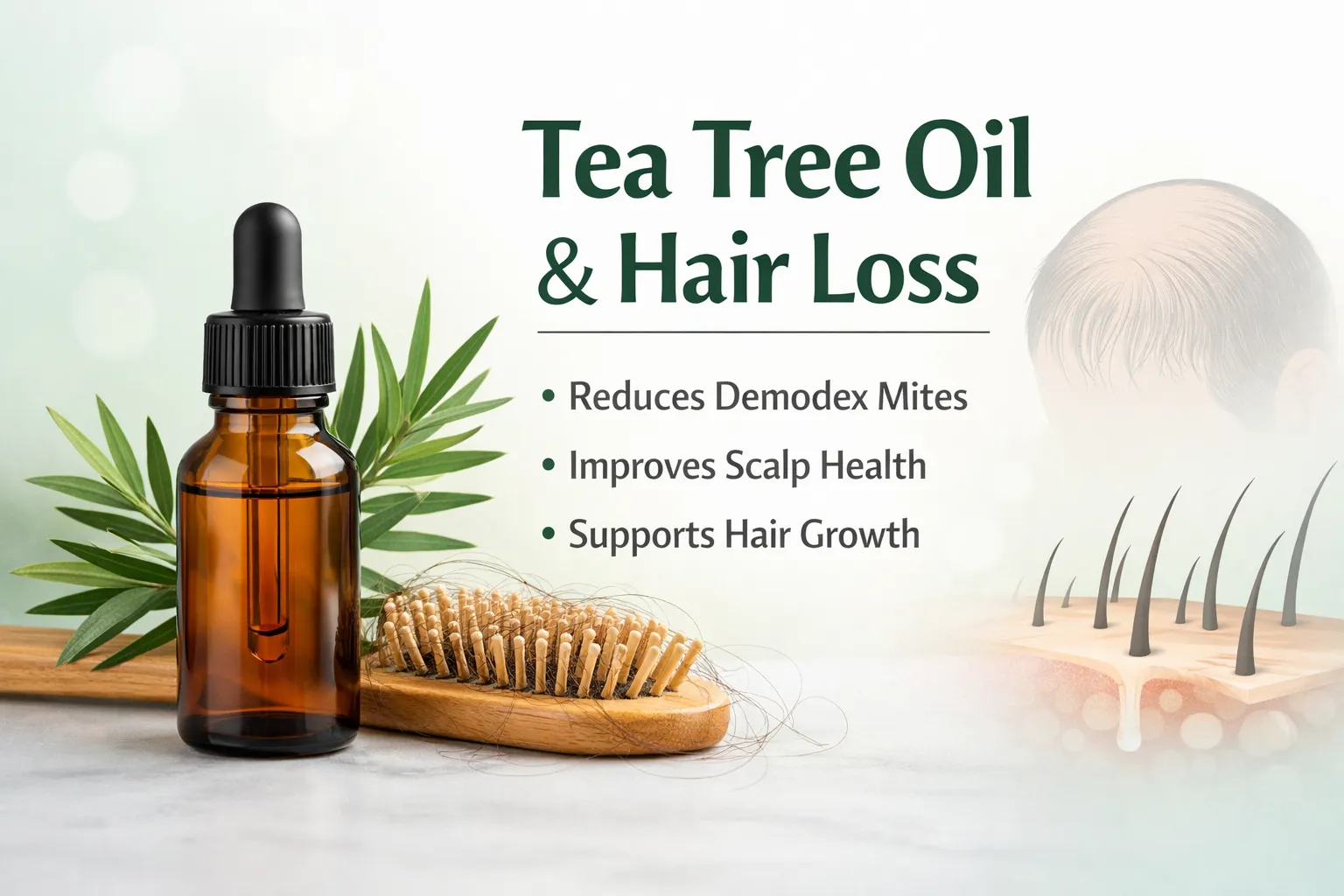
Taken together, current evidence supports a clinically useful nuance: Demodex is unlikely to be a universal “root cause” of male pattern baldness, but in a subset of patients—particularly those with scalp folliculitis-like symptoms, pruritus, erythema, scale, or treatment-refractory inflammation—high mite density may be a modifiable contributor to shedding or symptom burden.6,8
4. Tea Tree Oil and Androgenetic Alopecia (Male Pattern Baldness)
AGA’s primary drivers are androgen-mediated follicular miniaturization and genetically determined follicle sensitivity.1 As of current peer-reviewed clinical literature, there is limited direct evidence that topical TTO alone reverses miniaturization or produces robust regrowth in AGA. Instead, TTO is best positioned as a supportive scalp-care adjunct that may help optimize the follicular environment by reducing microbial/yeast-related flaking and potentially lowering Demodex burden and associated inflammation in selected individuals.2,5
In practice, this means TTO may improve:
- Itch, greasiness, and scale that coexist with AGA (via anti-dandruff effects).5
- Inflammatory symptoms potentially linked to mite overgrowth (via miticidal and anti-inflammatory actions).2,7
- General scalp “health signals” (reduced irritation and improved barrier comfort), which can reduce breakage behaviors like scratching and aggressive washing.
5. Safety, Tolerability, and Formulation Considerations
Essential oils can irritate skin; TTO is a recognized cause of irritant reactions and allergic contact dermatitis in some users, and risk may increase with oxidation (old/poorly stored products). A detailed review of contact allergy to TTO describes frequent reports of allergic contact dermatitis and emphasizes the importance of composition and product quality.9
Practical safety points:
- Prefer rinse-off products (e.g., shampoos) with established concentrations (e.g., 5% in the dandruff trial).5
- Patch test leave-on products; discontinue if burning, worsening redness, swelling, or persistent itching occurs.
- Do not ingest tea tree oil; ingestion toxicity is well documented in clinical literature and safety reviews.10
- If you have eczema, rosacea, or a history of fragrance allergy, consider dermatologist guidance before use.
6. Clinical Implications and Evidence-Based Positioning
For individuals concerned about “hair loss,” it is critical to distinguish:
- Follicular miniaturization (AGA) — typically requires AGA-targeted therapies for meaningful regrowth.
- Inflammatory or dysbiosis-associated shedding — may improve when scalp inflammation, yeast overgrowth, or ectoparasites are addressed.
A balanced evidence-based approach is: Use tea tree oil to optimize scalp conditions (dandruff/itch/inflammation; possible Demodex reduction), while using proven AGA therapies for male pattern baldness when appropriate. This “combined pathway” framing aligns with modern understanding that AGA is primarily androgen-driven but can be accompanied by inflammatory and scalp ecosystem factors in some patients.1,5
7. Limitations of the Current Evidence
- Few scalp-specific, randomized trials connect TTO use to objective hair density or hair count outcomes in AGA.
- Demodex–hair loss literature includes correlational studies and selected inflammatory case entities; causality and who benefits most remain uncertain.6,8
- Essential oil formulations vary widely; composition, stability, and concentration affect both efficacy and irritation risk.9
8. Conclusion
Tea tree leaf oil (Melaleuca alternifolia) has credible antimicrobial and anti-inflammatory mechanisms and human clinical evidence supporting benefit in dandruff with a 5% shampoo formulation.3–5 It also demonstrates miticidal activity against Demodex mites and is supported by clinical evidence in Demodex-related diseases, primarily in ophthalmic contexts.2,7 For hair loss, current evidence suggests TTO’s most defensible role is as a scalp-health adjunct—potentially improving flaking, itch, and inflammation, and plausibly reducing Demodex burden in selected symptomatic patients—rather than a standalone treatment for androgenetic alopecia.1,6,8
References
- Chen S, et al. Androgenetic Alopecia: An Update on Pathogenesis. (Review). 2025. PMC article. :contentReference[oaicite:0]{index=0}
- Lam NSK, et al. Comparison of the efficacy of tea tree (Melaleuca alternifolia) oil and terpinen-4-ol in Demodex-related disease. 2020. (Review). :contentReference[oaicite:1]{index=1}
- Carson CF, Hammer KA, Riley TV. Melaleuca alternifolia (Tea Tree) Oil: a Review of Antimicrobial and Other Medicinal Properties. Clinical Microbiology Reviews. 2006. :contentReference[oaicite:2]{index=2}
- Nogueira MNM, et al. Terpinen-4-ol and alpha-terpineol (tea tree oil components) inhibit production of inflammatory mediators in LPS-stimulated human macrophages. 2014. :contentReference[oaicite:3]{index=3}
- Satchell AC, et al. Treatment of dandruff with 5% tea tree oil shampoo. Journal of the American Academy of Dermatology. 2002. :contentReference[oaicite:4]{index=4}
- Nasiri-Jahrodi A, et al. The Association between Demodex Infestation and Hair Loss Severity. J Arthropod-Borne Dis. 2025. :contentReference[oaicite:5]{index=5}
- Gao YY, et al. In vitro and in vivo killing of ocular Demodex by tea tree oil. 2005. (PDF). :contentReference[oaicite:6]{index=6}
- Helou W, et al. Demodex Folliculitis of the Scalp: Clinicopathological Study of an Uncommon Entity. 2016. :contentReference[oaicite:7]{index=7}
- de Groot AC, Schmidt E. Tea tree oil: contact allergy and chemical composition. 2016. :contentReference[oaicite:8]{index=8}
- Kairey L, et al. Efficacy and safety of Melaleuca alternifolia (tea tree) oil for human health—A systematic review of randomized controlled trials. Frontiers in Pharmacology. 2023. :contentReference[oaicite:9]{index=9}