Rosemary Oil vs. Rosemary Oleoresin: Extraction, Chemistry, and Why a Combined Approach May Better Support Hair Loss Prevention and Growth
Keywords: Rosmarinus officinalis, rosemary leaf oil, rosemary leaf oleoresin, rosemary extract, carnosic acid, carnosol, rosmarinic acid, androgenetic alopecia, scalp inflammation
Abstract
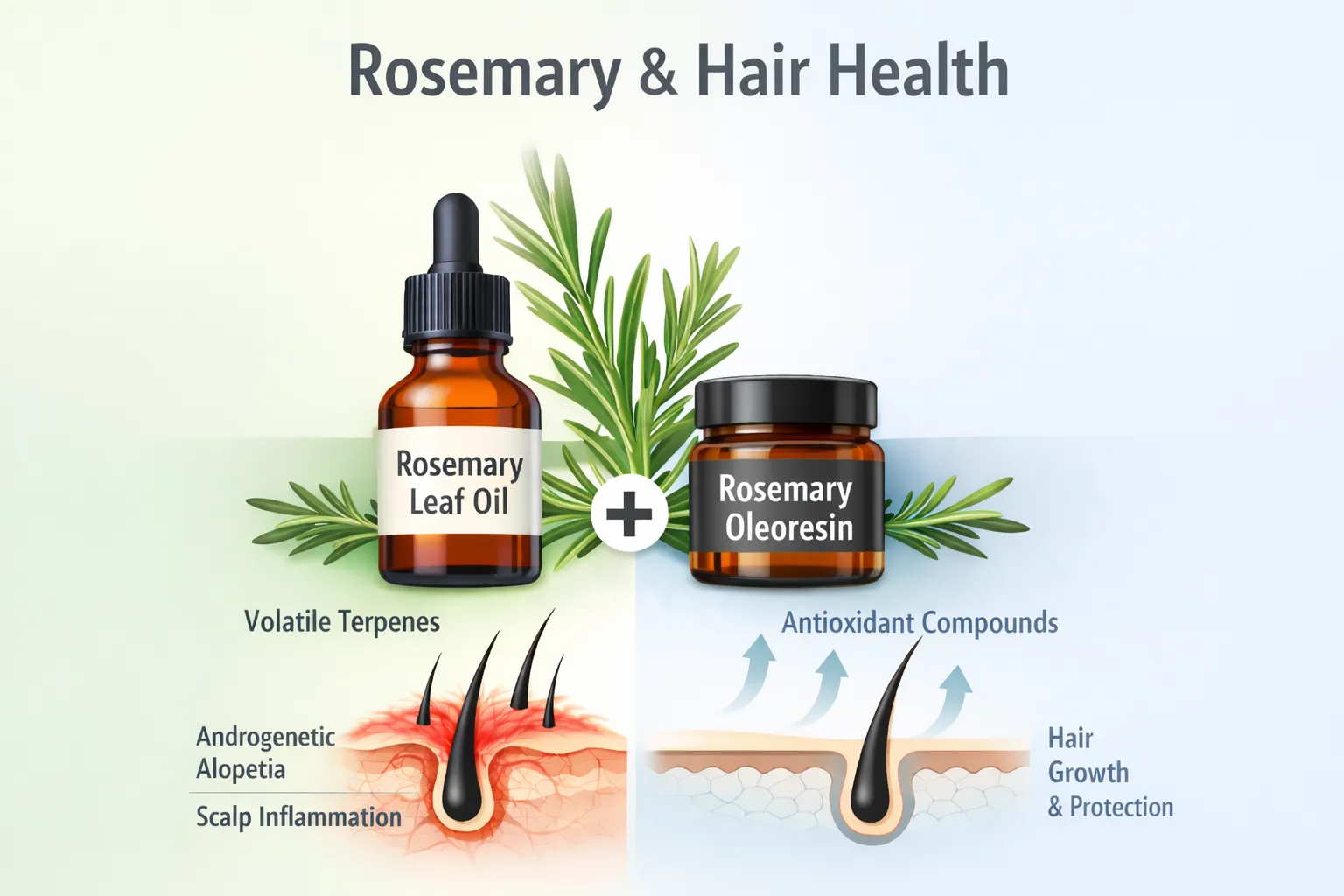
“Rosemary” can mean very different ingredients in topical hair products. Rosmarinus officinalis (rosemary) leaf oil is an essential oil dominated by volatile monoterpenes (e.g., 1,8-cineole, α-pinene, camphor), whereas rosemary leaf oleoresin (often labeled as “rosemary extract” or “rosemary oil extract/ROE”) is an oil-soluble, semi-viscous extract enriched with non-volatile antioxidant diterpenes and polyphenols such as carnosic acid and carnosol. These fractions differ in extraction method, chemical profile, stability, and likely biological targets. Clinical evidence supports rosemary essential oil as a topical option for androgenetic alopecia (AGA) in a randomized comparative trial (vs. 2% minoxidil), while regulatory and review literature strongly supports rosemary extract/oleoresin as a potent antioxidant source characterized by carnosic acid/carnosol. When used together in a well-formulated topical, rosemary leaf oil (volatiles) + rosemary oleoresin (lipophilic antioxidants) may provide complementary actions—supporting follicular microenvironment, reducing oxidative/inflammatory scalp stress, and improving product stability—potentially increasing overall efficacy and tolerability. Direct human trials testing the combination for hair growth are not yet well-established; thus, the combined-use argument is mechanistically plausible but remains an evidence-informed hypothesis requiring clinical confirmation.
1. Terminology and INCI: Why “Rosemary” on a Label Can Be Confusing
In cosmetic labeling, rosemary ingredients commonly appear as:
- Rosmarinus Officinalis (Rosemary) Leaf Oil — the essential oil (volatile fraction).
- Rosmarinus Officinalis (Rosemary) Leaf Extract — can refer to multiple extract types, including oil-soluble rosemary oleoresin/ROE enriched with carnosic acid/carnosol (non-volatile antioxidants).
The key point: leaf oil and oleoresin are not interchangeable. They are different fractions with different dominant actives, and they behave differently on the scalp and in formulations.
2. Extraction Differences
2.1 Rosemary Leaf Oil (Essential Oil): Distillation of Volatiles
Rosemary leaf oil is typically obtained by steam distillation (or hydrodistillation) of rosemary leaves/flowering tops. This captures volatile aroma compounds—primarily monoterpenes and monoterpenoids. Composition varies by chemotype and geography, but common major constituents include 1,8-cineole (eucalyptol), α-pinene, and camphor. [1],[2]
2.2 Rosemary Leaf Oleoresin (Oil-Soluble Extract/ROE): Solvent or Supercritical CO2 Extraction of Non-Volatiles
“Oleoresin” generally refers to a concentrated, semi-viscous extract containing non-volatile resinous and lipophilic compounds. Rosemary extracts used industrially (including food antioxidant additive “extracts of rosemary,” E 392) can be produced using solvent extraction (e.g., ethanol/acetone/hexane systems) or supercritical CO2 extraction; specifications and regulatory documents explicitly describe multiple manufacturing routes. [3]
These extracts are typically standardized or characterized by their content of key antioxidant diterpenes, chiefly carnosic acid and carnosol. Regulatory and safety evaluations often express rosemary extract exposure as the sum of carnosic acid + carnosol, reflecting their role as signature antioxidant components. [4]
3. Chemistry Differences That Matter for Hair and Scalp
3.1 Rosemary Leaf Oil: Volatile Terpenes (Fast-Acting Sensory/Surface Biology)
Rosemary essential oil is dominated by low-molecular-weight volatiles that readily evaporate and diffuse into the stratum corneum. Typical profiles highlight high proportions of 1,8-cineole, α-pinene, camphor, and related terpenes. [1],[2]
Potential scalp-relevant properties of this fraction include antimicrobial and anti-inflammatory signaling observed in broader essential oil literature, as well as sensory effects (cooling, “stimulating” feel) that can encourage consistent scalp massage routines—an adherence factor that matters for many topical hair approaches.
3.2 Rosemary Leaf Oleoresin: Lipophilic Antioxidants (Barrier-Compatible, Stability and Oxidative-Stress Support)
Rosemary oleoresin/ROE is valued commercially as an oil-soluble antioxidant because it is rich in carnosic acid/carnosol and related polyphenolic diterpenes. Review literature notes rosemary’s antioxidant activity is largely attributable to phenolic constituents in the leaves, including rosmarinic acid, carnosic acid, and carnosol. [5]
In practical terms for hair/scalp formulations, this fraction:
- Supports formula stability (helps slow oxidation of carrier oils and unsaturated lipids), which can reduce rancidity-related irritation and odor changes over time.
- Provides longer-residence actives (non-volatiles persist on skin/hair longer than essential oil terpenes).
- Targets oxidative and inflammatory pathways that may contribute to scalp microinflammation and hair fiber damage.
4. Evidence for Hair Growth: What We Know (and What We Don’t)
4.1 Human clinical evidence: Rosemary leaf oil in AGA
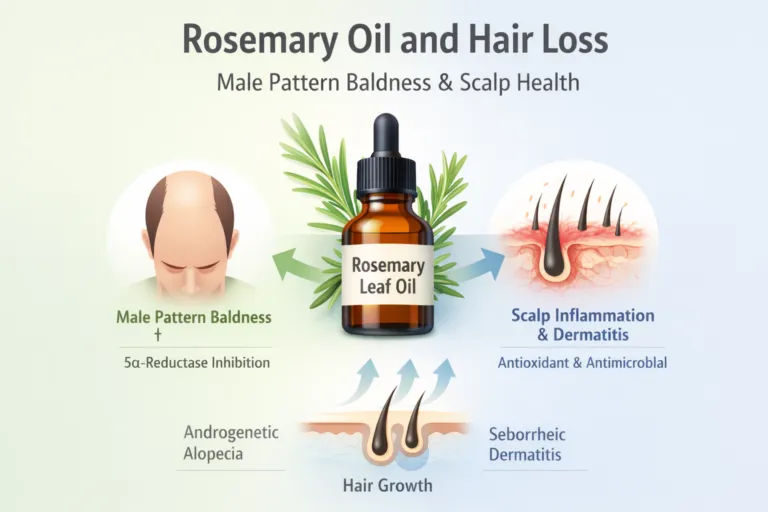
The strongest human evidence for rosemary in hair growth is a randomized comparative study in androgenetic alopecia where rosemary oil and 2% minoxidil were compared over 6 months; both groups improved hair count at 6 months, and the rosemary oil group reported less scalp itching. [6]
4.2 Mechanistic evidence relevant to oleoresin: Anti-androgen and follicle-support signals
Rosemary leaf extracts have shown testosterone 5α-reductase inhibitory activity in preclinical research, identifying diterpene-related constituents as contributors—mechanistically relevant because 5α-reductase drives conversion of testosterone to DHT, a key pathway in AGA. [7]
Additionally, contemporary reviews focusing on carnosic acid (a hallmark component of rosemary extracts/oleoresins) discuss multiple pathways potentially relevant to alopecia management, including antioxidant and anti-inflammatory activity and follicular regeneration support; however, much of this remains preclinical or mechanistic rather than proven in large human trials. [8]
5. Why Using Both Together May Increase “Efficacy” (A Complementarity Model)
There is not yet robust direct clinical evidence that “leaf oil + oleoresin” outperforms either alone for hair growth. Still, combining them is scientifically plausible for three reasons:
5.1 Broader active coverage: Volatile + non-volatile pharmacology
AGA and scalp health are multifactorial (androgen signaling, inflammation, oxidative stress, microbiome shifts, barrier disruption). A combined rosemary approach can provide:
- Leaf oil (volatile terpenes) that may support scalp comfort/microbial balance and user-perceived “activation,” potentially improving adherence.
- Oleoresin (carnosic acid/carnosol-rich fraction) that supplies durable antioxidant and anti-inflammatory support and may contribute to anti-androgen signaling observed in rosemary extract studies. [5],[7],[8]
5.2 Improved tolerability via formulation stability
Oxidized carrier oils can irritate sensitive scalps. Because rosemary extracts/oleoresins are widely used to retard oxidation of oils (a major reason rosemary extract is authorized as a food antioxidant additive), incorporating an oleoresin into an oil-based scalp serum may help keep the base lipids fresher, potentially reducing irritancy over time. [3],[4]
5.3 Better “dose efficiency” and lower essential-oil load
Essential oils can irritate or sensitize some users, especially if used undiluted or at high concentrations. If a formulation includes a standardized oleoresin fraction for non-volatile actives, it may allow a lower essential oil concentration while still delivering a broad rosemary-derived activity profile. This approach is aligned with general cosmetic safety principles for botanicals and fragrance ingredients (use appropriate dilution, avoid undiluted scalp application, patch test). [9]
6. Practical Formulation Considerations for Combined Use (Cosmetic/OTC Context)
The following points are formulation-centric and intended for educational purposes:
- Standardize the oleoresin/extract: Look for products that disclose carnosic acid/carnosol content (or use established suppliers that standardize ROE).
- Keep essential oil within conservative leave-on limits: Use a properly formulated product or dilute appropriately; irritation risk rises with higher concentrations and compromised scalp barriers.
- Vehicle matters: Scalp serums that enhance follicular delivery (non-irritating solvents/emollients) may perform differently than shampoos (short contact time).
- Time horizon: Hair growth interventions typically require months; set expectations accordingly and track with standardized photos.
- Adjunct strategy: For established AGA, botanicals may be most useful as adjuncts alongside evidence-based therapies (minoxidil/finasteride) under clinician guidance.
7. Limitations and Research Needs
- Combination trials are lacking: High-quality RCTs testing rosemary essential oil + rosemary oleoresin (standardized) vs. each alone and vs. placebo are needed.
- Chemotype variability: Essential oil composition varies widely by cultivar and geography, affecting reproducibility. [1],[2]
- Label ambiguity: “Leaf extract” can mean many things; future studies should specify extraction method and quantify key markers (e.g., carnosic acid, carnosol).
Conclusion
Rosemary leaf oil and rosemary leaf oleoresin are chemically and functionally distinct: the former is a volatile terpene-rich essential oil, while the latter is an oil-soluble extract enriched with non-volatile antioxidant diterpenes (notably carnosic acid and carnosol). Human evidence supports rosemary leaf oil as a topical option for AGA in at least one comparative clinical trial, while mechanistic and regulatory literature supports rosemary extracts/oleoresins as potent antioxidant fractions with bioactive constituents relevant to inflammatory and androgen-linked pathways. Used together in a carefully designed formulation, they may provide complementary scalp and follicular support—potentially improving overall outcomes and product stability—though direct clinical confirmation of superior hair-growth efficacy remains a key research gap.
References
- Chetia MP, et al. Rosemary (Rosmarinus officinalis L.) essential oil: A review. (2025). Notes common chemotypes and major constituents such as 1,8-cineole, α-pinene, camphor. [1]
- Fadili K, et al. The essential oil compositions of Rosmarinus officinalis L. (2020, PDF). Reports major constituents including 1,8-cineole, camphor, α-pinene (example profile). [2]
- Commission Directive 2010/67/EU. Specifications for extracts of rosemary (E 392); describes production processes including solvent extraction and supercritical CO2 extraction. [3]
- Younes M, et al. EFSA. Refined exposure assessment of extracts of rosemary (E 392). (2018). Expresses exposure as sum of carnosic acid + carnosol; supports characterization of rosemary extracts as antioxidant fractions. [4]
- Nieto G, et al. Antioxidant and Antimicrobial Properties of Rosemary (Rosmarinus officinalis). (2018). Reviews rosemary polyphenols including rosmarinic acid, carnosic acid, and carnosol as key antioxidant contributors. [5]
- Panahi Y, et al. Rosemary Oil vs Minoxidil 2% for the Treatment of Androgenetic Alopecia: A Randomized Comparative Trial. Skinmed. 2015. (PubMed: 25842469). [6]
- Murata K, et al. Promotion of Hair Growth by Rosmarinus officinalis Leaf Extract and Identification of an Active Constituent for 5α-Reductase Inhibition. Phytotherapy Research. (Published online 2012/2013 availability varies by indexing). Demonstrates 5α-reductase inhibition in rosemary leaf extract work. [7]
- Singh P, et al. Therapeutic Potential of Carnosic Acid in Alopecia. (2025). Review of pathways by which carnosic acid may support alopecia management (mechanistic/preclinical emphasis). [8]
- Fiume MM, et al. Safety Assessment of Rosmarinus officinalis (Rosemary)-Derived Ingredients as Used in Cosmetics. International Journal of Toxicology. 2018. Summarizes safety considerations; highlights potential for irritation/sensitization depending on use conditions. [9]