Pumpkin Seed Oil and Pattern Hair Loss: A Scientific Review of Clinical Evidence, Mechanisms, and Practical Considerations
Keywords: Cucurbita pepo, pumpkin seed oil, androgenetic alopecia, male pattern baldness, female pattern hair loss, dihydrotestosterone, 5α-reductase, phytosterols
Abstract
Androgenetic alopecia (AGA)—commonly called male pattern baldness (MPHL) and female pattern hair loss (FPHL)—is driven by genetic susceptibility and androgen signaling, especially dihydrotestosterone (DHT). Pumpkin seed oil (PSO) from Cucurbita pepo has attracted interest as a botanical intervention for hair loss because it contains fatty acids, tocopherols (vitamin E family), and phytosterols that may modulate pathways implicated in follicle miniaturization. This article reviews peer-reviewed human trials and supportive preclinical research on PSO for pattern hair loss, summarizes plausible biological mechanisms (including putative 5α-reductase/DHT modulation), and discusses safety, limitations, and research gaps. Current evidence includes a double-blind placebo-controlled trial in men using oral PSO for 24 weeks and a randomized comparative trial in women, alongside mechanistic and animal data. While results are promising, PSO should be considered adjunctive rather than a replacement for evidence-based therapies until larger, longer, independently replicated trials are available.
1. Background: Pattern Hair Loss Biology and Therapeutic Targets
AGA is characterized by progressive miniaturization of scalp hair follicles, shortening of the anagen (growth) phase, and a shift from thick terminal hairs toward finer vellus-like hairs in androgen-sensitive scalp regions. The conversion of testosterone to DHT by 5α-reductase and subsequent DHT–androgen receptor signaling are central in susceptible individuals, influencing downstream pathways and paracrine mediators that contribute to follicular miniaturization.1
FDA-approved treatments for AGA include topical minoxidil and oral finasteride for men; other modalities (e.g., low-level light therapy, platelet-rich plasma) are also used in clinical practice depending on patient context and local approvals.1
2. What Is Pumpkin Seed Oil (PSO)? Composition and Rationale
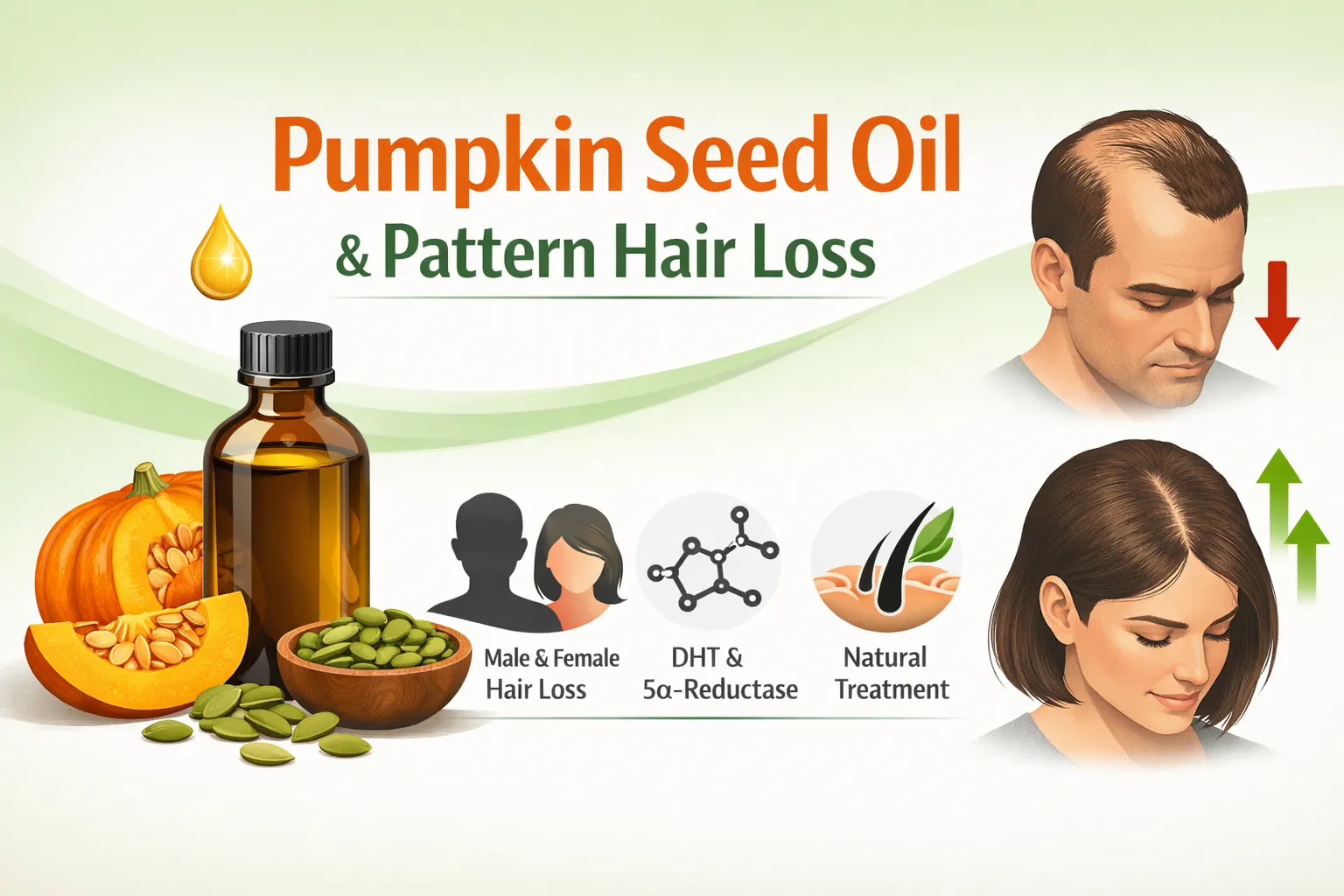
PSO is a lipid-rich extract from pumpkin seeds (Cucurbita pepo). Seed oils from this botanical source are typically rich in unsaturated fatty acids (notably linoleic and oleic acids), tocopherols (commonly γ-tocopherol), and phytosterols (e.g., β-sitosterol and related sterols). These constituents are relevant to skin and hair because they can support barrier function, provide antioxidant activity, and may influence inflammatory and androgen-related pathways.2
3. Clinical Evidence in Male Pattern Baldness
3.1 Randomized, Double-Blind, Placebo-Controlled Trial (Oral PSO)
The strongest direct clinical evidence for PSO in MPHL comes from a randomized, double-blind, placebo-controlled study in 76 men with mild to moderate AGA. Participants received 400 mg/day of PSO or placebo for 24 weeks. Hair growth was assessed using standardized photographs (blinded investigator ratings), patient self-assessment, and phototrichography for hair counts and thickness.3
Key outcomes reported:
- Hair count: Mean hair count increased by ~40% at 24 weeks in the PSO group versus ~10% in placebo, with significant between-group differences.3
- Global assessments: Self-rated improvement and satisfaction scores were higher with PSO than placebo at 24 weeks.3
- Hair thickness: Changes in measured hair thickness were similar between groups in this study.3
- Tolerability: Adverse events were not significantly different between groups, and no clinically meaningful laboratory safety signals were reported over 24 weeks.3
3.2 Interpretation
This trial suggests that oral PSO may increase hair counts in men with AGA over a 24-week period. However, it is a single study with a moderate sample size and limited duration relative to the chronic course of AGA. Replication, longer follow-up, and comparisons against standard therapies (or add-on designs) would help clarify effect size and durability.
4. Clinical Evidence in Female Pattern Hair Loss
4.1 Randomized Comparative Trial: PSO vs Minoxidil 5% Foam
In a randomized comparative trial, 60 patients with FPHL were assigned to treatment with PSO (n=30) or minoxidil 5% foam (n=30) for 3 months, with clinical and dermoscopic follow-up at baseline, mid-treatment, and study end. The PSO group showed significant improvements in dermoscopic parameters including reduced hair shaft diversity and vellus hair measures and increased upright regrowing hairs, supporting a potential therapeutic role in FPHL.4
4.2 Interpretation
The female trial supports that PSO may improve trichoscopic markers associated with FPHL over a short horizon (3 months). Because minoxidil is a benchmark therapy, comparative designs are clinically meaningful, but longer studies with standardized endpoints (e.g., target-area hair counts and patient-reported outcomes) are still needed.
5. Preclinical and Mechanistic Evidence
5.1 Topical PSO in an Androgen-Related Mouse Model
A mouse study evaluated topical PSO in a testosterone-induced hair growth retardation model. Topical PSO (notably 10%) significantly reversed testosterone effects on hair growth scoring and increased the proportion of follicles in anagen compared with testosterone-only animals, with effects approaching those observed with topical minoxidil in that model.5
5.2 Putative Antiandrogen Pathways: 5α-Reductase and Phytosterols
One hypothesized mechanism for PSO in AGA is modulation of androgen biology—specifically dampening DHT production by influencing 5α-reductase activity. While direct confirmation in human scalp tissue is limited, a relevant mechanistic signal comes from studies of pumpkin seed oil phytosterols (including Δ7-phytosterols) in benign prostatic hyperplasia (BPH) models, where pumpkin seed oil components were associated with lower 5α-reductase expression/activity and biological effects consistent with antiandrogen action in rats.6
5.3 Anti-inflammatory and Antioxidant Contributions
Beyond androgen pathways, PSO’s fatty acids and tocopherols may help by supporting scalp barrier function, lowering oxidative stress, and modulating inflammation—factors that can influence the follicular microenvironment. Reviews of cucurbit seed oils highlight these biochemical features and their relevance for cosmetic and skin/hair applications.2
6. Safety and Practical Considerations
In available hair studies, PSO was generally well tolerated over the studied durations, with no major safety signals reported in the male placebo-controlled trial over 24 weeks.3 Separately, an EMA herbal assessment report documents long-standing traditional use of Cucurbita pepo seed preparations in Europe and discusses marketed oral dosing ranges used in traditional contexts (e.g., soft-capsule products and food supplement doses).7
Important note: Supplements vary widely in extraction method, sterol profile, oxidation state, and dose. Clinical trial results cannot automatically be generalized to all over-the-counter products.
7. Limitations of Current Evidence
- Replication gap: The strongest male evidence is primarily one placebo-controlled RCT; broader replication is needed.3
- Short follow-up: AGA is chronic; longer studies (≥12 months) are important to assess durability and shedding after discontinuation.
- Heterogeneous endpoints: Trials use different measures (phototrichography, dermoscopy markers, global photo ratings), limiting cross-study comparability.3,4
- Mechanistic uncertainty in humans: Antiandrogen hypotheses are plausible but not definitively proven in human scalp follicles; supportive data often comes from animal or non-scalp models (e.g., BPH models).6
8. Conclusion
Pumpkin seed oil from Cucurbita pepo has clinically relevant preliminary evidence for improving parameters of pattern hair loss, including increased hair counts in a 24-week placebo-controlled trial in men and improved dermoscopic markers in a randomized comparative trial in women.3,4 Proposed mechanisms include modulation of androgen pathways (potentially involving 5α-reductase/DHT), along with anti-inflammatory and antioxidant effects attributable to its fatty acid and tocopherol/sterol composition.2,6 At present, PSO is best viewed as a promising adjunct with a favorable short-term tolerability profile, rather than a fully established standalone therapy. High-quality, longer-duration trials with standardized endpoints are needed to define optimal dosing, product standardization, long-term safety, and comparative effectiveness.
References
- Shin JW. Updates in Treatment for Androgenetic Alopecia. (Pathophysiology of AGA; DHT/5α-reductase role; overview of treatments). PMC. https://pmc.ncbi.nlm.nih.gov/articles/PMC12715879/.
- Sousa C, et al. Transforming By-Products into Functional Resources: The Potential of Cucurbitaceae Family Seeds in Cosmetics. Seeds. 2025;4(3):36. (Composition and bioactives of C. pepo seed oil relevant to skin/hair). https://www.mdpi.com/2674-1024/4/3/36.
- Cho YH, Lee SY, Jeong DW, et al. Effect of Pumpkin Seed Oil on Hair Growth in Men with Androgenetic Alopecia: A Randomized, Double-Blind, Placebo-Controlled Trial. Evidence-Based Complementary and Alternative Medicine. 2014:549721. (76 men; 400 mg/day; 24 weeks; hair count +40% vs +10%). https://pmc.ncbi.nlm.nih.gov/articles/PMC4017725/.
- Ibrahim IM, Hasan MS, Elsabaa KI, Elsaie ML. Pumpkin seed oil vs. minoxidil 5% topical foam for the treatment of female pattern hair loss: A randomized comparative trial. J Cosmet Dermatol. 2021;20(9):2867–2873. doi:10.1111/jocd.13976. https://pubmed.ncbi.nlm.nih.gov/33544448/.
- Hajhashemi V, et al. Beneficial effects of pumpkin seed oil as a topical hair growth promoting agent in a mice model. (Topical PSO reversed testosterone-induced hair growth retardation in mice). PMC. https://pmc.ncbi.nlm.nih.gov/articles/PMC6823528/.
- Kang XC, et al. Phytosterols in hull-less pumpkin seed oil, rich in Δ7-phytosterols, ameliorate benign prostatic hyperplasia by lowering 5α-reductase and regulating balance between cell proliferation and apoptosis in rats. Food & Nutrition Research. 2021;65. (Mechanistic support for 5α-reductase modulation by pumpkin seed oil components in animal models). https://pmc.ncbi.nlm.nih.gov/articles/PMC8693601/.
- European Medicines Agency (EMA). Assessment report on Cucurbita pepo L., semen. (Traditional use, product forms, dosing ranges in Europe; safety context). https://www.ema.europa.eu/en/documents/herbal-report/final-assessment-report-cucurbita-pepo-l-semen_en.pdf.