Lavender Essential Oil and Hair Loss: Evidence for Alopecia, Pattern Baldness, and Scalp/Hair Health
Abstract
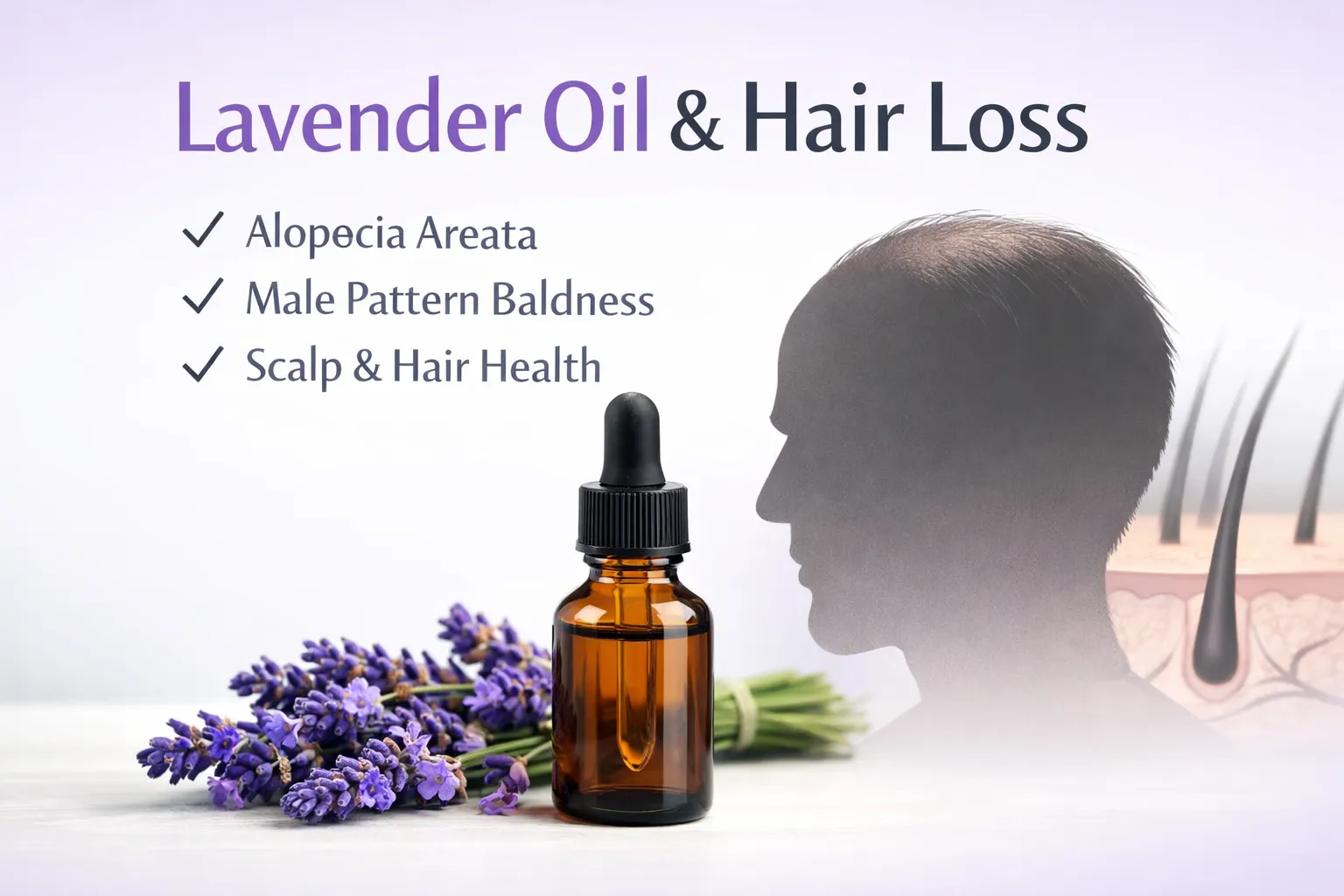
Lavender essential oil (LEO) is widely used in cosmetic and dermatologic contexts, yet its role in hair loss disorders is often overstated relative to the clinical evidence. This review summarizes human, animal, and mechanistic data on LEO and hair outcomes, with emphasis on alopecia areata (AA), androgenetic alopecia (AGA; “male/female pattern baldness”), and overall scalp health. A randomized, double-blind, controlled trial of an essential-oil blend including lavender reported higher improvement rates in AA than carrier oil alone, suggesting potential benefit in immune-mediated patchy hair loss when used in combination with other oils and scalp massage. In contrast, direct clinical evidence for LEO in AGA is limited; standard-of-care therapies remain minoxidil and (for many men) finasteride. Preclinical mouse studies indicate that topical LEO can promote anagen-associated histologic changes, but translation to humans remains uncertain. For scalp health, LEO-containing formulations have been studied for dandruff/seborrheic dermatitis targets (e.g., Malassezia-associated inflammation), with improvements reported in some trials of multi-ingredient shampoos. Safety considerations include irritation/allergic contact dermatitis risk and the need for appropriate dilution. Overall, the best-supported use-case is as an adjunctive, diluted topical component in AA-oriented aromatherapy protocols or scalp-care regimens, not as a stand-alone treatment for pattern baldness.
1. Introduction
Hair loss is a heterogeneous set of conditions with distinct biology and treatment responsiveness. Alopecia areata (AA) is an autoimmune, non-scarring alopecia characterized by patchy hair loss, whereas androgenetic alopecia (AGA) is a progressive, androgen- and genetics-influenced miniaturization of hair follicles, typically presenting as male or female pattern thinning. Because essential oils are readily available and culturally popular, lavender oil is frequently marketed for “hair growth.” A scientific assessment requires separating (i) evidence in AA (immune-mediated) from (ii) evidence in AGA (androgen-driven follicle miniaturization), and (iii) evidence for general scalp health (e.g., dandruff, seborrheic dermatitis, irritation).
2. Methods (Narrative Review Approach)
Evidence was synthesized from peer-reviewed clinical trials, preclinical animal studies, and mechanistic/in vitro literature indexed in biomedical repositories and journals. Priority was given to randomized controlled trials, peer-reviewed full-text sources, and reputable clinical guidance for AGA management.
3. Evidence for Lavender Oil in Alopecia Areata
3.1 Randomized controlled trial (essential-oil blend including lavender)
The strongest human evidence relevant to lavender oil and hair regrowth comes from a randomized, double-blind, controlled trial in AA using a blend of essential oils (thyme, rosemary, lavender, and cedarwood) in carrier oils, applied with daily scalp massage for seven months. Improvement occurred in 44% of participants in the active group versus 15% in the carrier-oil control group (P = .008).[1]
Importantly, this intervention tested a multi-oil blend plus massage, not lavender oil alone. The study also excluded individuals with androgenic alopecia, underscoring that the results should not be generalized to male pattern baldness/AGA.[2]
3.2 Interpretation
These data support the possibility that lavender-containing aromatherapy protocols may help some individuals with AA as an adjunct approach. However, because lavender was only one component of the active mixture, the specific contribution of lavender cannot be isolated from thyme/rosemary/cedarwood oils, carrier oils, and the mechanical effects of massage.
4. Evidence for Lavender Oil in Androgenetic Alopecia (Male/Female Pattern Baldness)
For AGA (male pattern baldness), there is currently limited direct clinical evidence that lavender oil alone reverses follicular miniaturization. Contemporary medical reviews and clinical guidance emphasize that the most evidence-based treatments include topical minoxidil and (for many men) finasteride, with additional procedural or off-label options in selected patients.[10], [11]
A recent randomized, placebo-controlled trial evaluated a rosemary–lavender oil formulation (and a rosemary–castor comparator) over 90 days in healthy participants and reported improvements in multiple hair metrics versus coconut oil placebo.[6] While encouraging for “hair quality” outcomes, this study does not establish efficacy for AGA specifically (e.g., patterned miniaturization endpoints in clinically diagnosed AGA cohorts), and it tested a combination product rather than lavender monotherapy.
Bottom line for AGA: lavender oil may be reasonable as a scalp-care adjunct (properly diluted) but should not be positioned as a replacement for evidence-based AGA therapies when the goal is to slow progression or regrow miniaturized hair.
5. Preclinical and Mechanistic Evidence Relevant to Hair Growth
5.1 Mouse model findings
In a C57BL/6 mouse model, topical lavender oil (3% and 5% in a vehicle) applied for four weeks was associated with morphologic and histologic findings consistent with hair growth promotion, including increased hair follicle number, greater follicle depth, and increased dermal thickness compared with controls.[3] Animal models can indicate biological plausibility, but they do not reliably predict clinical benefit in human AGA or AA without confirmatory trials.
5.2 Delivery systems and blends
Because essential oils are volatile and have formulation challenges, nanoemulsion and blended-oil approaches have been explored. One study developed a nanoemulsion containing lavender, peppermint, and rosemary oils and reported hair-growth promotion in C57BL/6 mice with comparisons to 2% topical minoxidil in that model.[7] These results support formulation feasibility and mechanistic plausibility but still require human confirmation for specific hair-loss diagnoses.
5.3 Proposed mechanisms (hypothesis-generating)
Proposed pathways by which lavender-containing topicals might support scalp/hair outcomes include anti-inflammatory and antioxidant effects, modulation of local microbial factors, and improved scalp comfort that may reduce scratching and inflammatory stressors. Reviews of lavender oil describe anti-inflammatory activity in experimental contexts, but clinical translation depends on concentration, formulation, and diagnosis-specific biology.[9]
6. Lavender Oil and Overall Scalp Health (Dandruff/Seborrheic Dermatitis, Irritation, Microbial Balance)
Scalp inflammation and dysbiosis (notably involving Malassezia species) contribute to dandruff and seborrheic dermatitis in susceptible individuals. A study evaluating essential oils (including lavender) and a fruit extract against Malassezia species reported antifungal testing and a clinical trial of a shampoo containing multiple ingredients (citron seed oil, lavender oil, rosemary oil, and citrus extract), with improvements in sebum, erythema, dandruff, and lesion extent reported in the clinical component.[8]
Practically, this supports a narrower, more defensible claim: lavender oil may contribute to scalp comfort and hygiene as part of a multi-ingredient scalp-care formulation, rather than acting as a stand-alone “hair regrowth” drug.
7. Safety, Tolerability, and Practical Use Considerations
7.1 Irritation and allergic contact dermatitis
Essential oils can cause irritant or allergic contact dermatitis, particularly when applied undiluted, oxidized (aged), or at high concentrations. In vitro work has shown dose-dependent cytotoxicity of lavender oil and major constituents (e.g., linalool, linalyl acetate) to human skin cells, supporting the need for cautious, diluted use on skin/scalp.[4]
7.2 Dilution guidance (general, not medical advice)
In cosmetic practice, essential oils are typically diluted into a carrier oil (e.g., jojoba, grapeseed) or formulated in rinse-off products. Patch testing a small area first, avoiding broken skin, and discontinuing if burning, rash, or worsening itch occurs are prudent steps—especially for individuals with eczema, psoriasis, or known fragrance allergies.
7.3 When to seek medical evaluation
Rapid shedding, patchy hair loss, scalp pain/burning, scarring, or hair loss accompanied by systemic symptoms warrants medical assessment. AGA and AA have distinct diagnostic signs and evidence-based treatments; correct diagnosis matters for outcomes.
8. Conclusions
Lavender oil has some supportive evidence in hair-loss contexts, but the strength of evidence depends heavily on the diagnosis and formulation:
- Alopecia areata: The best clinical evidence involves an essential-oil blend including lavender, with improved outcomes versus carrier oil alone in a randomized controlled trial.[1]
- Male pattern baldness / AGA: Direct evidence for lavender oil is limited; standard therapies such as minoxidil and finasteride remain the most evidence-based options for many patients.[10], [11]
- Scalp health: Lavender-containing multi-ingredient shampoos and essential-oil formulations have shown improvements in dandruff/seborrheic dermatitis-related measures in some studies, consistent with a supportive scalp-care role.[8]
Overall, lavender oil is best framed as an adjunct—potentially helpful for scalp comfort and, in combination protocols, AA-related regrowth—rather than a proven monotherapy for androgen-driven pattern baldness.