Saw Palmetto and Pattern Hair Loss: Mechanisms, Clinical Evidence, and Safety
Abstract
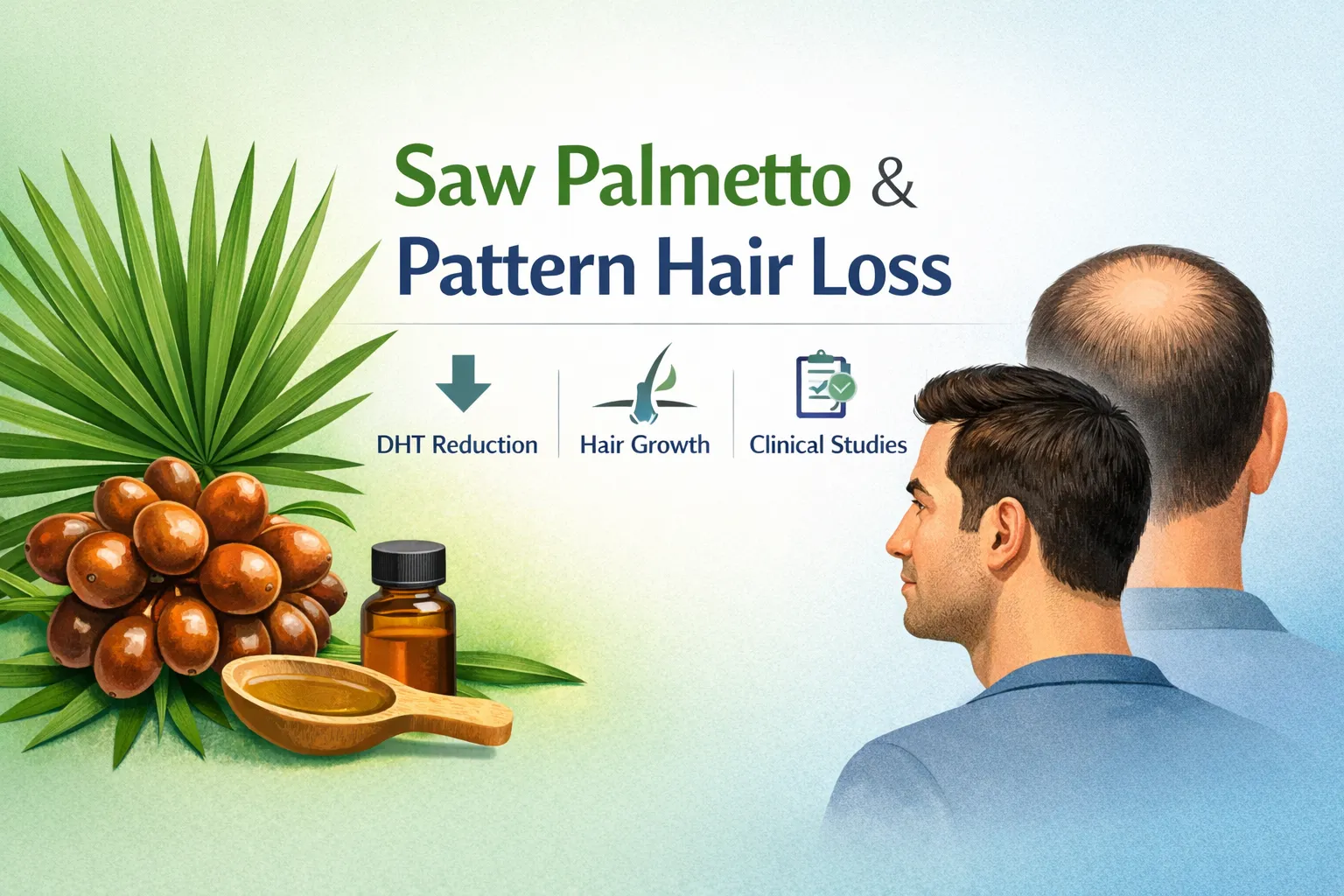
Pattern hair loss (androgenetic alopecia, AGA)—including male pattern baldness—is driven largely by androgen signaling (notably dihydrotestosterone, DHT) in genetically susceptible follicles. Fruit extracts of Serenoa repens (syn. Serenoa serrulata, “saw palmetto”) contain lipidosterolic fractions (fatty acids + phytosterols) that can inhibit 5α-reductase (types I and II) and may modestly reduce DHT-related follicular miniaturization. This article synthesizes mechanistic data and human clinical evidence on oral and topical saw palmetto preparations for AGA. Across small-to-moderate clinical studies, saw palmetto—alone or in combination formulas—has shown improvements in hair shedding metrics and/or hair density, generally with a favorable tolerability profile. However, the evidence base is heterogeneous (formulations, endpoints, populations, study rigor), and effects appear smaller than established pharmacologic therapies such as finasteride. Larger, independent, well-controlled trials with standardized extracts and objective phototrichogram outcomes are needed.
Keywords: androgenetic alopecia, male pattern baldness, saw palmetto, Serenoa repens, Serenoa serrulata, 5α-reductase, dihydrotestosterone, nutraceutical, topical botanical
1. Introduction
Androgenetic alopecia (AGA) is the most common cause of progressive scalp hair thinning in men and also affects many women. In AGA, susceptible follicles gradually miniaturize, producing shorter, finer hairs. DHT—formed from testosterone by 5α-reductase—plays a central role in male AGA and in subsets of female pattern hair loss. Conventional treatments with the strongest evidence include topical minoxidil and oral finasteride (men). Interest in botanical alternatives has grown due to concerns about sexual adverse effects or long-term medication use.
Saw palmetto refers to fruit-derived extracts of Serenoa repens (historically also labeled Serenoa serrulata). These extracts are widely used for urologic indications and have been studied for hair loss because of their anti-androgen pathway effects, particularly 5α-reductase inhibition.
2. Methods (Narrative Review Approach)
A targeted literature scan was conducted focusing on:
- randomized or controlled human studies in AGA using oral or topical saw palmetto preparations;
- systematic reviews discussing saw palmetto for alopecia;
- mechanistic/preclinical studies addressing 5α-reductase inhibition or relevant bioactive composition; and
- safety reviews of Serenoa repens extracts.
Priority was given to peer-reviewed articles and indexed abstracts (e.g., PubMed), supplemented by review literature for context.
3. Biologic Rationale and Mechanisms
3.1 Bioactive composition
Saw palmetto fruit oil/extract is rich in free fatty acids and phytosterols (e.g., β-sitosterol). Composition varies substantially by extraction method (e.g., hexanic vs supercritical CO₂ extracts), which is clinically important because bioactivity may not be equivalent across products.
3.2 5α-reductase inhibition and DHT modulation
Multiple lines of evidence support Serenoa repens extracts as inhibitors of 5α-reductase (types I and II), providing a mechanistic bridge to AGA biology. In at least one placebo-controlled clinical study of standardized saw palmetto oil (VISPO™), oral administration was associated with a significant reduction in serum DHT versus placebo, alongside improvements in hair shedding and density metrics.
3.3 Additional pathways (inflammation, proliferation, scalp environment)
Beyond androgen modulation, saw palmetto extracts have been described as having anti-inflammatory and antiproliferative effects in related tissues and models, which could theoretically influence perifollicular microinflammation observed in AGA. The clinical relevance for scalp follicles remains incompletely established.
4. Clinical Evidence in Pattern Hair Loss (AGA)
4.1 Oral and topical standardized saw palmetto oil: 16-week randomized, placebo-controlled trial
A double-blind, placebo-controlled, four-arm study randomized 80 men and women (ages 18–50) with mild-to-moderate AGA to: oral VISPO™ (capsules), topical VISPO™ (20% formulation), or respective placebos for 16 weeks. Reported outcomes included reduced hair fall (comb/pull tests), increased hair density, and reduced serum DHT in the oral group versus placebo.
Interpretation: This trial supports biological activity (DHT reduction) and modest clinical benefit in shedding/density measures over 16 weeks. Limitations include short duration for AGA biology and product-specific standardization that may not generalize to other extracts.
4.2 Saw palmetto vs finasteride: 2-year comparative study (men)
A two-year clinical study comparing finasteride 1 mg/day with Serenoa repens 320 mg/day in men with AGA reported improvement with saw palmetto but confirmed superior efficacy for finasteride. The authors also noted saw palmetto’s effects appeared more prominent at the vertex than the frontal scalp.
Interpretation: This longer follow-up suggests saw palmetto may help some patients, but its effect size is likely smaller than finasteride.
4.3 Botanically derived 5α-reductase inhibitors including saw palmetto: early placebo-controlled evidence
A randomized, double-blind, placebo-controlled pilot trial evaluated botanically derived 5α-reductase inhibitors in men with AGA, including a liposterolic extract of Serenoa repens (often combined with other actives such as β-sitosterol). The study reported that a majority of actively treated participants were rated as improved by blinded assessment at the final visit.
Interpretation: While supportive, this evidence is limited by small sample sizes and combination formulations, making the saw palmetto–specific contribution difficult to isolate.
4.4 Topical saw palmetto products for male AGA (24-week pilot)
A 24-week pilot study assessed topical products containing Serenoa repens extract in men with AGA. Topical delivery is mechanistically appealing (local follicular exposure with potentially less systemic hormone effect), but topical studies are often limited by design features and product mixtures, increasing risk of bias.
4.5 Newer proprietary fatty-acid extracts for “thinning hair” populations
A randomized, double-blind, placebo-controlled study reported interim 90-day results for an oral proprietary bioactive fatty acids extract derived from saw palmetto in adults with self-perceived thinning hair, describing early improvements and favorable tolerability in a mixed-sex population.
5. Safety, Tolerability, and Practical Considerations
5.1 Adverse events
Systematic review evidence indicates Serenoa repens is generally well tolerated, with most reported adverse events mild and similar to placebo; commonly reported effects include gastrointestinal symptoms and occasional headache, while serious events were rare and causality uncertain.
5.2 Drug interactions and special populations
Because saw palmetto may have hormonal activity, caution is typically advised in pregnancy and in people using hormone-modulating therapies. Patients on anticoagulants/antiplatelet agents or with upcoming surgery often discuss supplement use with clinicians as a precaution. Supplement quality and composition vary widely; outcomes may depend on using a standardized extract with demonstrated bioactive content.
5.3 Lessons from BPH evidence (context, not direct hair evidence)
Cochrane reviews in benign prostatic hyperplasia (BPH) have found that saw palmetto alone provides little to no improvement in urinary outcomes versus placebo, illustrating that clinical efficacy can be indication-specific and that product variability matters. This does not negate potential hair effects but underscores the need for rigorous, indication-specific trials in AGA.
6. Discussion
Overall, clinical evidence suggests saw palmetto fruit extract can produce modest improvements in hair shedding and small increases in hair density in some AGA populations, with generally good tolerability. The most persuasive signals come from controlled studies using standardized preparations and from longer comparative follow-up where improvement is observed but appears less robust than finasteride.
The literature remains challenging to interpret because:
- Formulations differ (oil vs extract; oral vs topical; extraction method; fatty acid/phytosterol standardization).
- Combination products are common, confounding attribution to saw palmetto alone.
- Endpoints vary, with some studies emphasizing shedding tests or subjective assessments rather than standardized phototrichograms.
- Duration is often short relative to hair-cycle biology (many AGA trials require 24–52 weeks for maximal cosmetic change).
Clinical positioning (evidence-based): Saw palmetto may be considered an adjunct or alternative for individuals who cannot tolerate or do not wish to use finasteride, with the caveat that expected gains are typically smaller and product selection/standardization matters.
7. Conclusion
Saw palmetto fruit extracts have a plausible biologic mechanism for AGA via 5α-reductase inhibition and, in some standardized preparations, measurable DHT reduction. Human trials—though heterogeneous—suggest modest improvements in shedding and hair density, with a generally favorable safety profile. For male pattern baldness, evidence indicates benefit is likely inferior to finasteride, but saw palmetto remains a reasonable candidate for further study and may serve as an adjunctive option when standardized, quality-controlled products are used.
References
- Sudeep HV, et al. Oral and Topical Administration of a Standardized Saw Palmetto Oil Reduces Hair Fall and Improves Hair Growth in Androgenetic Alopecia Subjects – A 16-Week Randomized, Placebo-Controlled Study. (2023). PubMed PMID: 38021422. PubMed
- Rossi A, et al. Comparative effectiveness of finasteride vs Serenoa repens in male androgenetic alopecia: a two-year study. Int J Immunopathol Pharmacol. 2012;25(4):1167–1173. PubMed PMID: 23298508. PubMed
- Prager N, et al. A randomized, double-blind, placebo-controlled trial to determine the effectiveness of botanically derived inhibitors of 5-alpha-reductase in the treatment of androgenetic alopecia. J Altern Complement Med. 2002;8(2):143–152. PubMed PMID: 12006122. PubMed
- Wessagowit V, et al. Treatment of male androgenetic alopecia with topical products containing Serenoa repens extract. Australas J Dermatol. 2016;57:e76–e82. PubMed PMID: 26010505. PubMed
- Ablon G. The Safety and Efficacy of a Proprietary Bioactive Fatty Acids Extract From Saw Palmetto (Serenoa repens) for Promoting Hair Growth and Reducing Hair Loss in Adults With Self-Perceived Thinning Hair: 90-Day Results. (2025). PMC
- Evron E, et al. Natural Hair Supplement: Friend or Foe? Saw Palmetto, a Systematic Review in Alopecia. (2020). PMC
- Agbabiaka TB, et al. Serenoa repens (saw palmetto): a systematic review of adverse events. Drug Saf. 2009;32(8):637–647. PubMed PMID: 19591529. PubMed
- Tacklind J, et al. Serenoa repens for benign prostatic hyperplasia. Cochrane Review / evidence summary (updated). Cochrane
- Zhou L, et al. Effects of dietary supplements on androgenetic alopecia. Frontiers in Nutrition. (2025). Frontiers